
From Contigo’s (unpublished) annals. Future posts will be reflections upon our time aboard, including a few stories.
—
One of the most popular questions we received while living aboard Contigo was “What is the scariest moment you have had on the boat?“. Fortunately, we had very few mishaps, but one overnight tested our ability to address something fast, and for me in particular, was a reminder to keep a bigger perspective. The title is a nod to our dear friend and mentor, Jim Moloney.
One evening in November 2021, Karl and I departed Charleston, South Carolina, en route to Jacksonville, Florida. The previous day we had gunkholed in a narrow anchorage just inside the inlet, where Contigo was surrounded by cattails. Except for the occasional recreational speed boat, everything lay perfectly still. We had waited for a weather system to pass through, intent on using the winds from the north to push us south to warmer climes. Before sundown, we raised anchor and set our sails before entering the Atlantic, where we made a sharp turn to the right and headed due south. The night was chilly and getting colder as the northerly winds picked up, higher than forecasted. We each took a watch on deck, managing our course and looking out for marine traffic. Once the sun set, the increasingly brisk wind had encouraged the waves to escalate as well. Beneath the unlit new moon it was difficult to tell where the black wave of water steadily lifting Contigo up ended, and the black sky, not yet peppered with stars, began. Contigo steadily increased her pace and it became more uncomfortable in the cockpit. Though the cold breeze was a reminder of why we were heading south, I longed for the warmth of our bed and the still anchorage where we had slept 24 hours ago.
Karl, noticing my forlorn gaze from the cockpit into the warm cabin, came up the companionway and graciously relieved me. Given the conditions, he said, we were better off staying down below and checking outside every 10 minutes for traffic.
With the typical night watch schedule abandoned, we stripped off our “outside” clothes and into our cozy “indoor-wear.” We snuggled up in the salon below, each with a bowl of popcorn and The Great British Baking Show, determined that this night at sea could at least have some civility, starting with Paul Hollywood’s critique of bread crusts. We wondered out loud how long it would take us to make some banana bread if we started now. We had all the ingredients; flour, eggs, bananas…BAM.
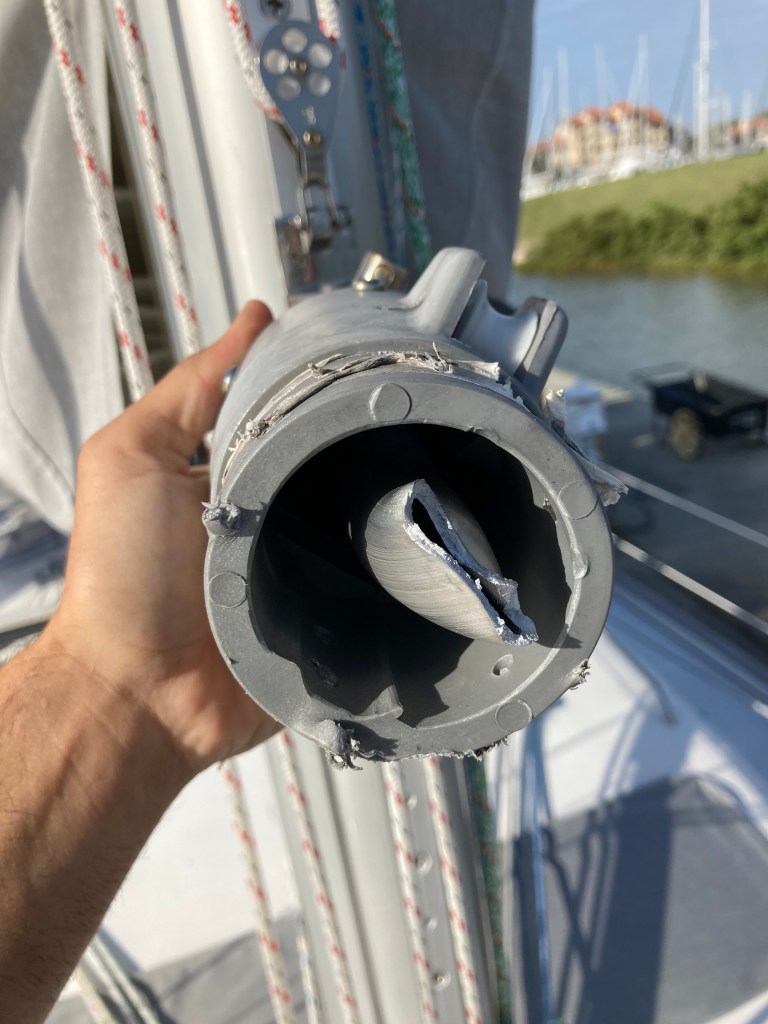
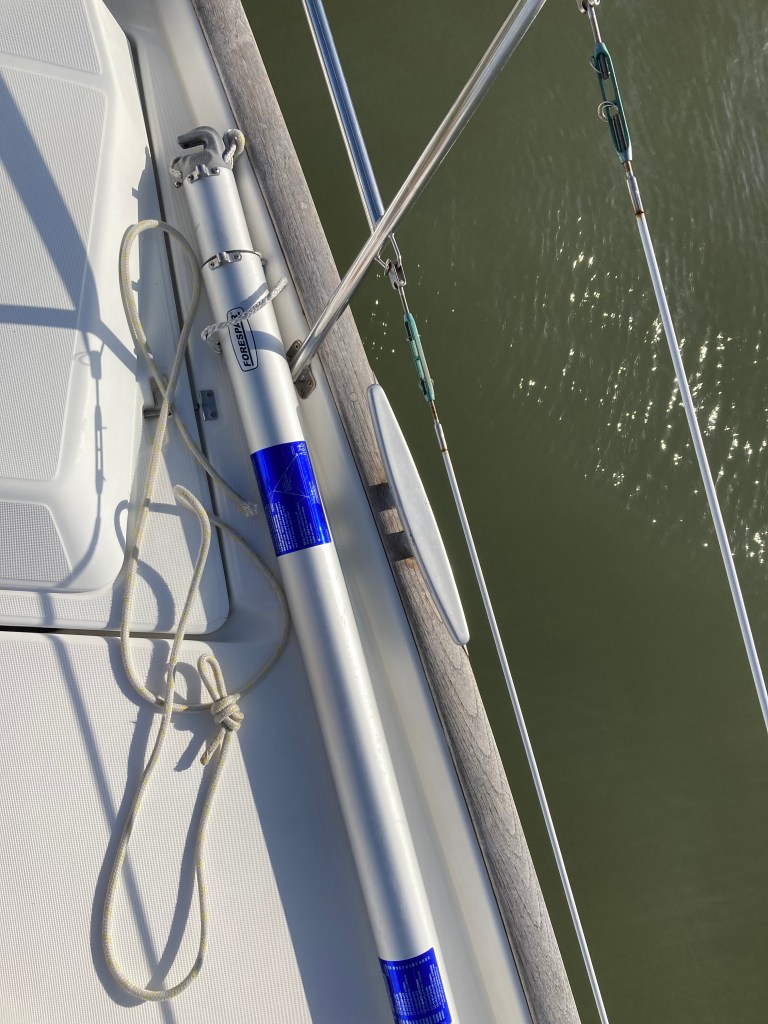
If you are a responsible cruiser, you’re likely laughing at our naivete. The ocean knows when you are not paying attention, and its reminders to wake up can range from good-natured and funny to deadly. Noises on a boat are a big deal and are typically categorized into three levels: normal/everyday, we should probably fix that, and, to paraphrase Harrison Ford from Six Days Seven Nights, “Oh s—, we’re gonna die.” The noise was enough to shake us out of our banana bread wishes and Paul Hollywood dreams. We clambered up the companionway to see what mess awaited us. Karl flipped on the deck lights and shone a flashlight forward of the mast. Our hearts sank as we witnessed the maelstrom before us. The sail configuration we had been using, called wing-on-wing, requires pushing the mainsail out on one side of the boat as far as it will go, and on the other side, using what is called jib pole to pull the jib, or forward most sail, as far out as it will go, so the sails make a “V,” with the tip at the front of the boat. The brand new jib pole, which was highly recommended to us by a salesman and fellow boater who confirmed the equipment was sturdy (“gale wind appropriate,” per his personal experience racing boats) had completely snapped off at the connection point on the mast. Now the forward sail and its lines, with nothing to hold them taut, were flailing about, like an angry octopus orchestrating a concerto on our foredeck.
With no time to mourn the loss of our tranquil evening, Karl had to go forward, untangle the lines and secure the jib pole, which if left rolling about the deck could fall off and smash a hole in Contigo’s side. He quickly pulled on the requisite nighttime offshore gear: foulies, lifejacket, headlamp, and tether. He also grabbed a knife that we often used for fishing, a birthday gift I had given him when we were still working in finance but had nonetheless started accumulating sailing paraphernalia. He began to creep alongside the boat, towards the foredeck. Contigo, meanwhile, despite her bungled sail configuration, had continued careening down what felt like massive waves. Between Contigo’s surfing and the wind, on Karl’s first step forward the birthday knife flew out of his hand and was quickly swallowed into the darkness, an offering to Poseidon. I yelped, I wish I could say out of concern for Karl, but for the knife. My mind flashed to the day I purchased it while sitting at my desk in Manhattan – at that time a city slicker with only dreams of owning a boat. Karl, recognizing he was second to the wellbeing of an inanimate object, was appropriately displeased, but duty called, and he grabbed another (less sentimental) knife, this time between his teeth, and made his way to the foredeck.
While he fought with the angry conducting cephalad ahead, I tried not to be utterly useless, but there wasn’t much to do but watch him tangle amidst lines and sail. This was excruciating. Aside from making slight course adjustments to use the wind to our advantage for untangling the lines, I could only monitor the situation and hope he did not fall or otherwise get injured. I took to repeating a melody out loud: “Please be okay, Please be okay, Please be okay.” I remembered how just five hours ago I had been stressed out about a work call and analysis I needed to do. As I glanced around at the situation, that concern now seemed utterly absurd. Nothing puts things in perspective like watching your partner, whom you can only hope doesn’t fall overboard into a 1,000 foot abyss, re-accessorize your boat while underway in complete darkness. Time was non-existent – it could have been 15 minutes or an hour – but finally Karl yelled for me to commence furling in the untangled jib, putting it to bed, so to speak, until we got into port.
Karl returned to the cockpit, sweating, despite the chill of the early November morning. “Are you okay?” I asked Karl. He exhaled, and affirming yes, all but collapsed down in the cabin. I stopped at the top of the companionway and surveyed the scene one more time. The excitement, sounds, and energy of just a few moments ago had dissolved into the sea. Other than the severed pole, now securely latched to the stanchions due to Karl’s quick work, there was no sign of the pandemonium that had just ensued. All was right again. I thought, “I am okay.”
 twoanchovies.com