During a week-long meditation retreat last July, the teachers introduced the idea of “integration” on the second or third day – much earlier than expected. It felt well-timed. Karl and I were already starting to make sense of our nine years aboard Contigo, revisiting big and small moments that only revealed their weight in retrospect.
The prelude to our first overnight journey, including seasoned cruisers telling us we needed to memorize the light patterns of cargo ships and oil tankers (well-intentioned, but not necessary) and our evening chart plotting while sitting at a local restaurant, was much more angst-inducing than the trip itself, which is the sign of a good, if not delightful passage. We found ourselves just past the stage of bemusement (there were a few moments of “What are we doing on this boat?”) to one of joy and wonder, emotions derived from being alone at sea in a sailing vessel.
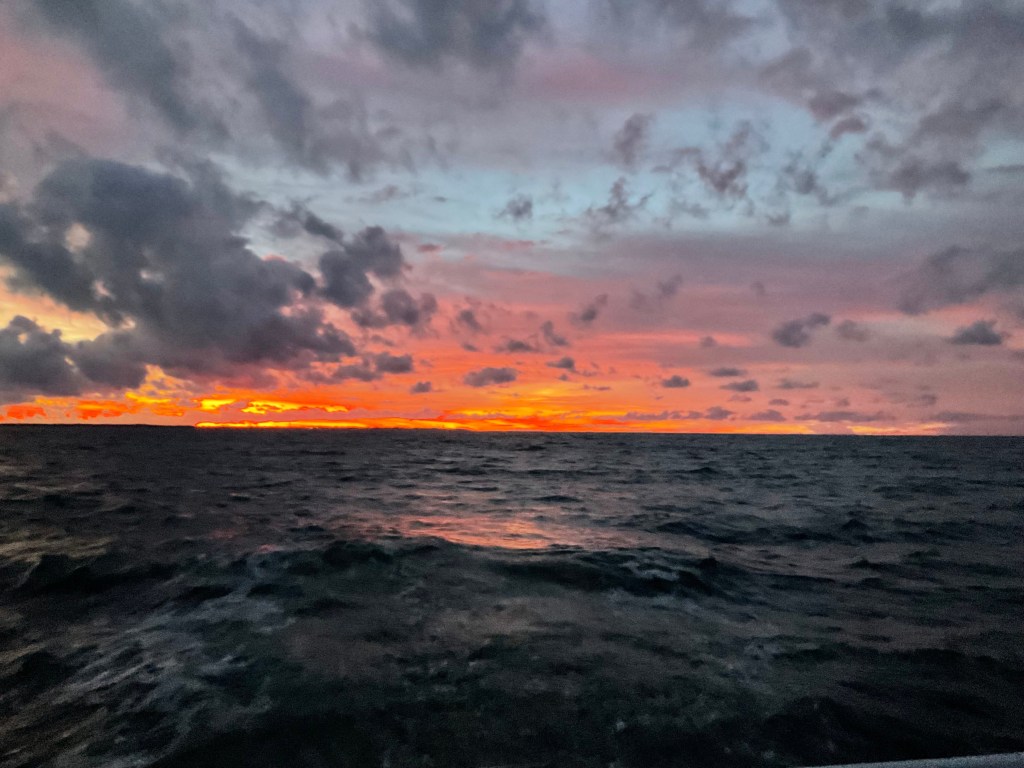
That’s not to say we didn’t each experience a small share of difficult feelings. Anxiety, boredom, and tiredness all made an appearance, a typical trifecta for long passages. When we left the dock in Lewes, Delaware, early in the morning, we pardoned the thick fog that had settled overnight, figuring it was simply the warm air of the summer moving over the still slightly cooler water, and would “burn off” within a few hours. It didn’t. The persistent fog was a result of the windless day, which meant that we had to run our engine for 24 hours straight. The only advantage of the fog was that it prepared us for the evening, when we were initiated into our first full night sail under a moonless, starless sky. As the fuzzy grey of the day morphed into a black curtain, our trust – established during daylight hours – that our heading was unobstructed was further tested. Our visual detection was limited to the rare sighting of the perplexing lights possessed by much larger commercial vessels, behemoths that appeared both far away and much too close for comfort. We had radar and AIS, though we were still learning how to use them.
Well past midnight, we were both up on deck, the lesser of the two discomforts. We had planned to alternate night watches, each taking a turn for four hours, while the other rested down below, but the cabin felt inhospitable.
There was a nauseating mixture created by our fresh basil plant and diesel fumes that hung suspended in the windless night. All the sounds were new and unnerving. There was the roar of Sven (our Volva Penta) plowing through the unbreaking waves. The gentle tap-tap at the trough of each wave made by our newly acquired anchovy tin artwork hanging on the bulkhead, its soft but steady noise akin to hearing a leaky water faucet. The faint creaking as Contigo’s inner and outer parts twisted and yielded, shouldering the impact of the waves.
We would learn to refine these details. But for this first evening, our curiosity as well as desire not to abandon the other kept us up on deck. Perhaps most importantly, our joint presence offered me a (very much false) sense of security. I felt that nothing bad could happen with us sitting side-by-side at the helm, though we could not see five feet in front of Contigo.
Around 2AM, a gruff voice suddenly flooded Contigo’s cockpit. Our VHF vibrated with the urgency of a man who had a deadline to meet and wasn’t in the mood to tolerate green pleasure boaters.
Doing away with any pleasantries, he authoritatively told us he was a towboat pushing a barge and could not see our vessel (meaning our AIS was not functioning correctly). One of the most important rules of the sea, despite what may be written in guides or textbooks, is “might is right,” and we wanted to ensure we were well out of his path. Any sluggishness we felt immediately dissipated as we scrambled to troubleshoot our mercurial AIS and decipher our radar.
As Karl went to reset the AIS, the VHF came alive again.
“Hey Sailboat.”
We affirmed our presence despite the generic call.
“Yeah. Fix your devices. Don’t get run over out here,” he added, the VHF picking up a twinge of pity, if not care. Karl and I ran through the options, assuming we couldn’t get our AIS to work. We couldn’t stop (or “pull over”) because we were unfamiliar with the inlets along the New Jersey shoreline. Lack of visibility plus shallow waters and proximity to shore together implied more risk to us than the deeper waters that, except for headstrong towboats, were empty because other vessels had decided to wait out this weather. But through some magic that seems to only appear on marine vessels, the AIS was working again after the second reboot.
We recommitted to the journey. Karl stood at the helm, and I collapsed in the cabin below, the smells and sounds no longer so bothersome nor foreign.
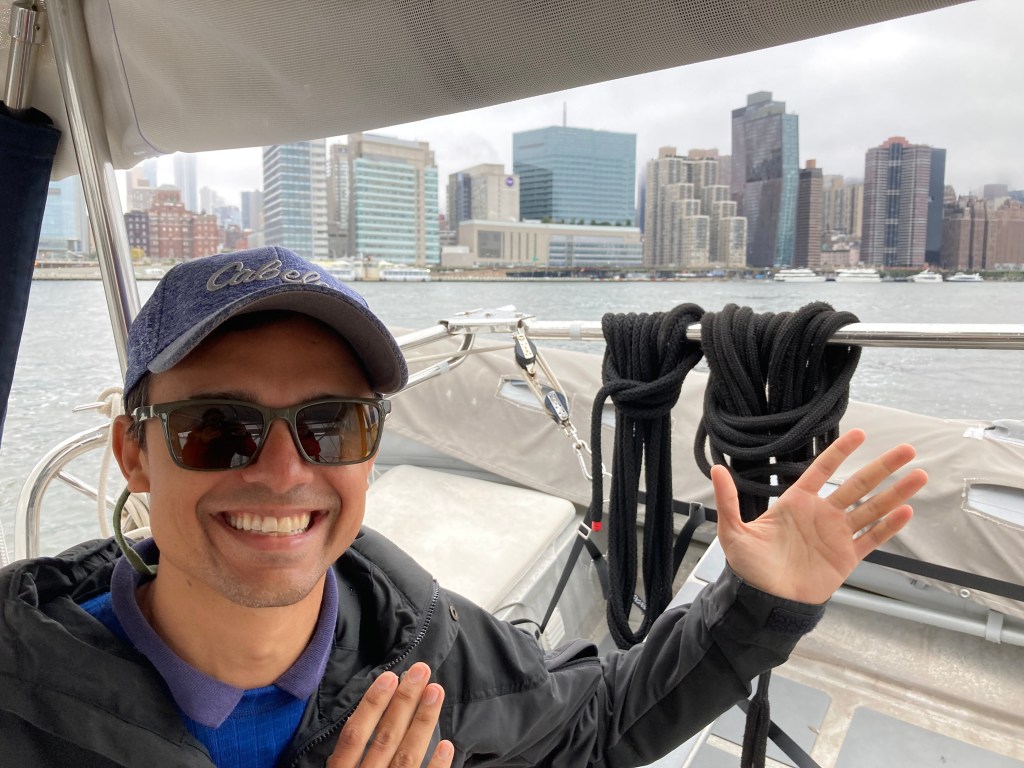
At 7AM, guided by the welcoming committee of the Sandy Hook red and green buoys, we anchored in a bay not ten miles (as the crow flies) from the apartment Karl and I had departed less than a year ago. This was our first time seeing the city from the outside in, and we could all too easily imagine the rush-hour cacophony well underway. We high-fived, indulged in warm showers, and after tucking into Karl’s arepas and eggs, crawled into the forward berth, the night watches complete.