
Karl and I did not know the names of any our neighbors when we lived in New York. Elevator rides were strictly reserved for arming or disarming the personal shield through which the chaos of the city (including a brief exchange with a neighbor) could not penetrate. Cruising was the opposite. In an hour of cocktails, we would learn more about a neighboring boat in the anchorage than in two years of sharing a wall with a fellow Brooklyner. From Summer/Fall 2021.
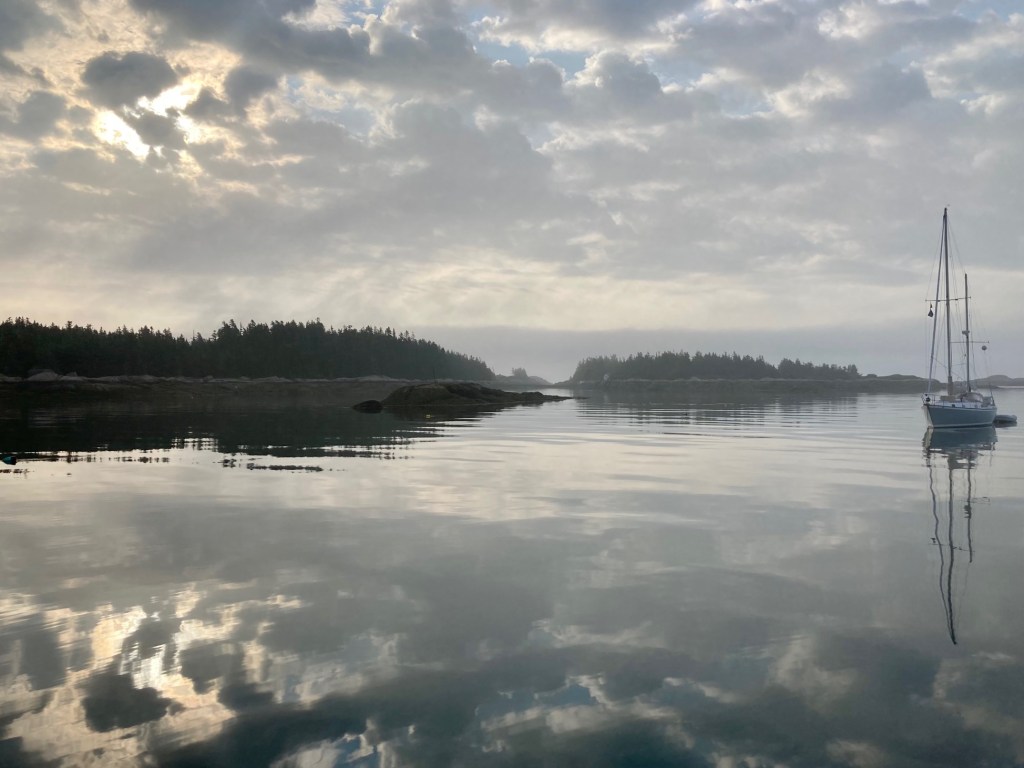
In the distance we heard the low hum and growl of a lobsterman’s diesel engine. I was on watch, which meant my easy morning of drinking coffee and reading was over. After three days offshore, we were making our final approach to Roque Island, the easternmost island belonging to Maine before the border of Canada. Now I needed to take care that our track did not lead us straight into a trap, the lines of which could easily foul our propeller. This sounds relatively easy, but boats do not move in straight lines. A few small heading changes needed for a better wind angle or to adjust for current could suddenly lead us into a trap that earlier was “not a factor” (our verbal short-hand for “Stay the course, Contigo won’t run over that thing over there.”).
We arrived without mishap, and after our ritual high-five post anchor down, we scurried below, the afternoon fog that had slowly settled in the anchorage since our arrival coaxing us indoors for hot showers and a hearty meal.
Some cruisers, after being offshore, cannot wait to get on land to explore the sights, grab a beer, and eat a meal not prepared in a 6-foot-by-6-foot boat galley. We were not those cruisers. We are quite lucky our relationship is such that we could not only spend days offshore together, the only escape route the open sea, but even at anchor would often choose to stay aboard, each of us immersed in our own activity, only coming up on deck to occasionally throw some organic bits from our dinner overboard. This was one of those times. The layers of grey outside gave us limited incentive to go anywhere, and we had no schedule. We would get around to exploring at some point.
A few months later, on our cruise back south, we stopped in southern Virginia, where some gracious Ocean Cruisers Club members hosted us at their dock for the trifecta of sailor luxuries: hot showers, laundry machines, and a home-cooked meal. As we sat outside chatting around the fire, a cruiser friend called. We all gathered around a table, our hosts putting their friend on speakerphone to introduce us.
“Sailing vessel Contigo? I thought you guys were dead!” Our hosts, sailors with decades of experience, wondered who (or what), in fact, they had invited into their home.
We all looked at the pregnant phone for a few moments, Karl and I unprepared to defend our very much aliveness. Maybe we should not have declined the oysters earlier that evening.
Their friend had also been anchored at Roque Island a few months ago. He had watched our boat, at first fascinated that its occupants seemed inoculated from cabin fever. Concern started to creep in when after a few days he had seen no movement aboard, only the gentle swaying of Contigo making arcs around the anchor.
“I thought you might be one of those single-handing old-timers that just keeled over.”
He had hoped for the best and moved on; respect for a fellow cruiser’s independence generally trumps any attempt to establish community. But it was life-affirming to hear a complete stranger had been worried about our well-being. Despite our best efforts, our introverted tendencies were being kept in check.
 twoanchovies.com
Hello Conner and Karl, Thanks for the update; another interesting and fascinating story! UB
LikeLike
Thank you UB! Sending big hugs!
LikeLike