“I don’t give advice. Only suggestions.”
He had stopped by to drop off a bottle of mezcal. We had just seen him the previous evening for a tasting, so it didn’t seem like there would be much small talk. But we soon learned that when we were with Gustavo, there was always something to say.
As his son waited patiently in the still running car, Gustavo looked at both of us. Even in the growing darkness of the evening, I could see his eyes twinkling. I cradled the bottle of Jabalí he had delivered gingerly in my arms.
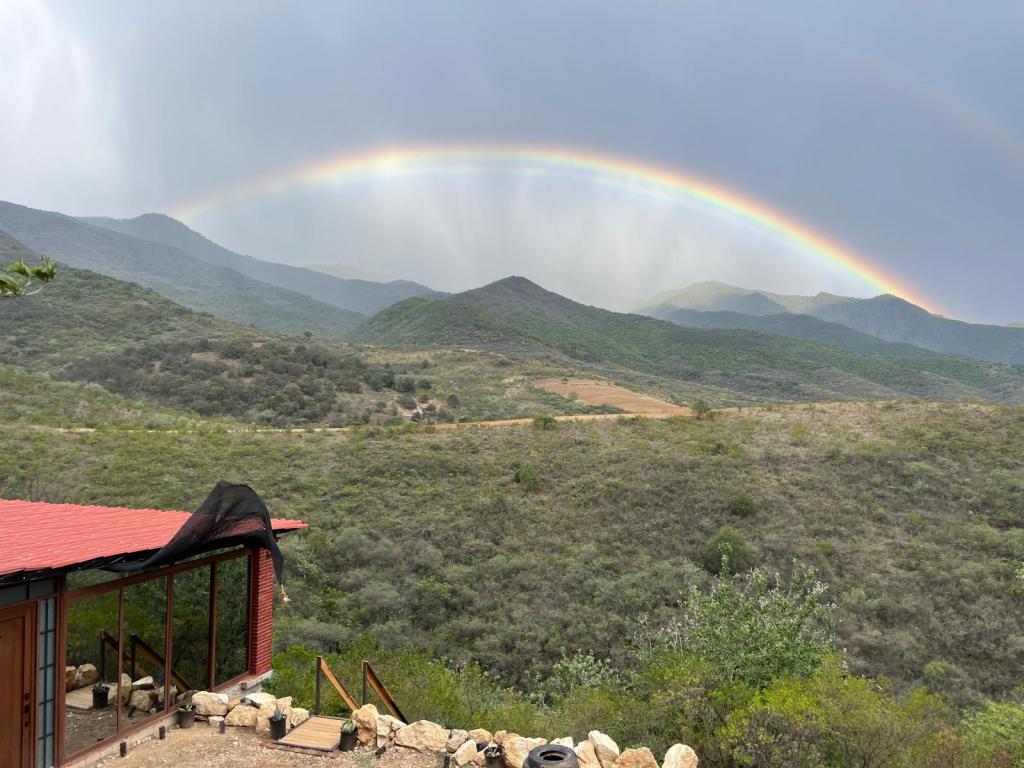
He pointed. “See that ridge over there? Every morning, at six-thirty, that’s where the sun rises. Without fail. Are you up to see it?”
He wasn’t necessarily asking us directly. It was more a gentle reminder.
The previous evening, he had hosted us at his home for a mezcal tasting. Perched on the side of a small cliff, the tidy house sat somewhat in defiance of the dusty expansiveness just in front of it. Upon arriving, I noticed the new door and windows, the tiny decorative plastic flowerpots hanging from hooks along the outside. They all seemed incongruous with the encroaching earth around and below the house, where the small steep overhang descended into a vast garden of cactus and maguey.
The three of us stood silently outside for a few minutes. In a sweeping gesture, Gustavo traced the not-too-distant mountains shining in the late afternoon light. He explained this land would remain as is, unoccupied, as it was communal and development was prohibited.
He ushered us into his home, modest but well kept; a plush sofa, massive TV, kitchen, and dining table. The bedrooms along the perimeter were for himself and his children. Where he felt most natural was not the comfortable couch or the hammock he had installed for his granddaughter that was draped in the living room. It was behind his handmade wooden bar, which was placed right next to a floor-to-ceiling sliding window that ran the full length of the house. He pulled up two stools and encouraged us to sit down.
Sitting closest to the open window, I had an unobstructed view of the beautiful landscape. The breeze had picked up, signaling the sun was descending, taking with it the heat of the afternoon. There was little to no boundary between my stool and the 50-foot drop into the garden, which housed the plants we were about to taste. I peered down, the proximity offering a sense of communion.
Gustavo poured the first flight, asking us to calmly take a sniff, first closing our left nostril, sniffing only from the right, then repeating on the other side, to smell with both nostrils, then to pause, reflect, and finally sip. What did we smell? Butter. Fruit. Citrus. Salinity. Herbs. Grass.
Each varietal he shared with us he treated as children that he had created – which was the truth – it was not unlike how an artist treats their work. But he offered without attachment, more than willing to relinquish his creation to new friends. He was confident in their debut, either not caring or blissfully unaware that for the last three pours he had lovingly said “This one is my favorite.”
Each mezcal arrived with a story (and for me, new Spanish vocabulary).
Several years ago, after a variety of jobs that included baking and delivering fresh bread, Gustavo entered the world of mezcal through apprenticing with a maestro (teacher in Spanish).
The maestro was just like any master craftsman. Tough, impatient, and disciplined, but full of wisdom – if one could survive his tutelage. He welcomed Gustavo but warned him their work began each day at four in the morning en punto.
Gustavo had arranged to sleep on the floor in the family tienda, surrounded by the product he would soon learn to cultivate. The store had no electricity – a precaution against the flammable liquid. Soon enough Gustavo would be able to walk at night and early morning by memory.
It was a restless night. Even though he was an early riser, Gustavo worried about oversleeping. As he lay awake in those precious final moments before rising, he heard practiced footsteps, followed by the soft glug glug of a liquid being poured into a glass. Fearful he would have to contend with a thief before the first day of his job, he quickly pulled on his work clothes. There was the maestro, standing at the counter, pouring himself a small glass of mezcal.
The maestro was an alcoholic. But the glass of mezcal each morning, fasted, nourished his body such that he did not reach for another drink that day. No more, and no less. The “poison” had transformed into a medicine for him.
This was Gustavo’s first lesson. It was evident in the way he poured for us that it wasn’t his last.
Gustavo was quietly leading us somewhere, and he knew the terrain long before we knew where we were. The order and selection of mezcals seemed to unfold in a story, one in which Gustavo gently showed us not simply what we liked, but what we needed. When Karl loved one while I loved another, Gustavo smiled. These were simply stops along the way. He had already known.
Darkness had fallen hours ago. Gustavo’s son had returned from work and was cooking up what would soon be accompanied by warm tortillas. This was our cue to graciously depart. It would not be our only tasting together.
Karl and I arrived home around midnight, eager to make our own late-night snack of guacamole, totopos, and quesadillas. With the best of intentions, we would try to get up early the following morning. Gustavo would already be awake.