
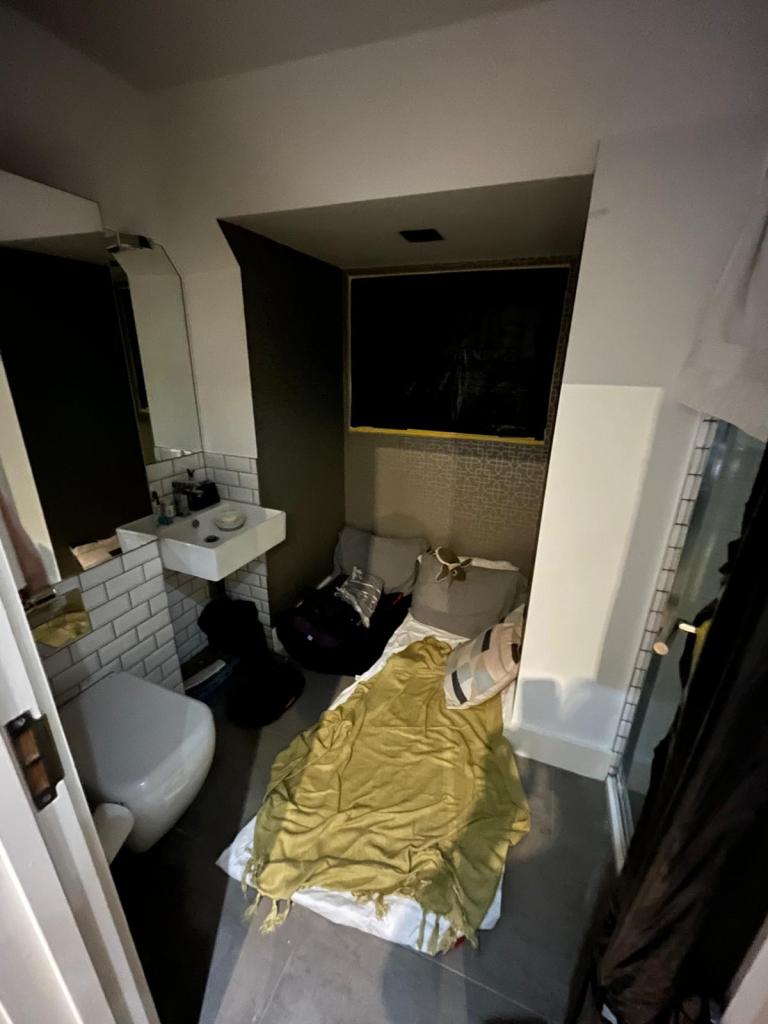
On one of those nondescript days between Christmas and New Years last year, Karl and I spent the afternoon traipsing the high street of Golders Green, searching for Gorilla tape and garbage bags. Armed with these suspicious looking goods, Karl expertly taped up the single window, doorway, and ceiling lights of his brother and sister-in-law’s third-floor bathroom. This was to be my home for the next three days. In complete darkness.
No devices accompanied me. My only human connection was through Karl’s visits to bring me meals, tea, and water. What was originally planned as two daily meal deliveries became three after Karl researched maximum carbon dioxide accumulation, just in case the bathroom’s air extractor wasn’t up to snuff. Thanks to his concern, in addition to breakfast and lunch, I was also gifted a nightly delivery of popcorn and tea.
This was my first dark retreat. I had explained this eccentricity to my immediate family as simply an opportunity to rest and slow down.
The first night went by shockingly fast, considering I was sleeping on a bathroom floor. But thanks to years of dozing on Contigo’s lazarette, the nest I had created out of two thick yoga mats felt downright luxurious. The floors were cozy from radiant heating. Temperature control was an upgrade from the hot water bottles we had clutched to during overnight watches.
Karl’s soft knock the first morning signaling he had arrived with breakfast woke me from a deep slumber. Our method was that I was to put on my eye mask and knock back. Karl would then open the door, leave the food, do a brief check on my water levels, gather any notes I had scribbled down, close the door, and knock when the room was “fully sealed” once again.
Fingers were my eyes. After Karl’s deliveries, I would slowly creep to where I imagined he had placed the food, my fingertips first touching the stem of a banana or the smooth, rounded skin of an apple. My first bite of food – a banana – that morning was delightful. The taste of the ordinary fruit felt elevated because my visual field was unable to inspect it for flaws. And, as is always the case, food tastes better when someone brings it to you. I savored it, placing it on the plate unfinished, then myself lying down to rest once again. I continued this pattern of resting, nibbling, and sipping cacao tea until the last banana bite. The first full day was just this, a nourishing flow of lying on the floor and seated meditation, with a break in between to happily eat whatever Karl brought me. During the following two days I incorporated a little more activity: some gentle yoga, more seated meditation, soft chanting. But the core practice remained the same – do nothing.
My meditation teacher had reminded me before entering the retreat that darkness is neutral – it would simply reflect the energy I brought in. So I was grateful that what was our bathroom just 24 hours before had transformed into a supportive cocoon, encouraging me to take as long as I needed in everything I did, or importantly, did not do.
The retreat resonated with me so much that with the support of my teacher, I signed up for another one in Mexico: one week in a room specifically created for dark retreat.
When I arrived at the center, I felt an excitement that was different from other group-based retreats I have attended. The owner showed me my room, which was more akin to a cave; I needed to step down into it from the sidewalk outside. It smelled of earth and faint mold, enough that the host assured me it would dissipate once the air extractor and fan were running (she was right). While not the most pleasant odor at first, after the retreat was over, I was nostalgic for it, wistfully smiling when I smelled traces of it on the clothes and blankets I had brought into the room.
While arranging my space, I uncovered two large spiders and a psychedelic centipede with blue tipped limbs that had made the darkness their home in between guests. After carefully repositioning these creatures outside, I walked down to the beach for a final sunset dip. I returned, lit a candle, slightly unscrewed the only light, and sat on the twin bed, the variable flickering of the candle easing me into the dark. When my eyes started getting heavy, I blew it out, officially entering into complete blackness.
Over the next week, I naturally developed a little routine of morning practice (practice just meaning yoga and meditation), breakfast, rest, afternoon practice, rest, dinner, shower, bed. I could still relatively tell whether it was day or night by the delivery of meals, but between these reference points, time didn’t feel linear. It bent, slowed, sped up – it was also completely meaningless.
These routines were pleasantly familiar. I thought of all the overnight journeys aboard Contigo in which Karl and I would intentionally keep the lights off starting at dusk. We would shower, use the head, walk about the cabin, prepare tea and snacks by touch and sound. I quickly learned how to open and close the appropriate seacocks by feel only, even knowing how much to open the faucet to wash my hands without dousing myself. Time aboard also exhibited a flexible nature – passing much too quickly during off-watch, slowing to an imperceptible crawl when Contigo herself was stalling in light winds.
—
Each day during the retreat, I noticed it was increasingly less about “I should be doing this” and more my body leading the way. Long bouts of resting on the floor were intermingled with sun salutations or soft yoga. These quick transitions to physical activity mirrored the rhythm of longer passages, where hours of lazily lounging on Contigo’s lazarette would suddenly give way to a few moments of concentrated activity.
The excitement and anticipation I had felt at the start of the retreat soon transformed into steadiness and equanimity. There were peaks and valleys, but generally emotions were not lingering guests, overstaying their welcome.
But on my last full day, I was reminded of how tenuous this state can be.
I woke feeling fully rested. I made my bed, brushed my teeth, washed my face, and went to my yoga mat to start my morning practice. Part of this included a meditation I had been speaking out loud over the past week, deriving something between comfort and strength from the sound of my own voice. I knew my audience contained at least one gecko, whose squelchy mating call reminded me he was listening. Typically, when I finished, there was a little bit of time, and then breakfast would arrive. After what felt like a luxuriously long savasana (a yoga pose in which you lie on the floor, releasing all your muscles), my breakfast still hadn’t arrived. Not bothered, I shifted to a sitting meditation for a bit. Then I returned to savasana. I was not really hungry, but noticed my quiet mind had started to chatter a bit; “There is no way it’s still before breakfast time. Did they forget? Are they messing with me?”
Some indeterminable amount of time later, my body wanted to move, so I decided to start my afternoon practice. This consisted of slightly more vigorous yoga, another meditation, more resting on the floor. The return to these activities was calming. Still no sign of breakfast.
I had entered the retreat with a relative degree of sureness. I memorized the position of my toiletries so I knew where to pick up and replace each item. With the lights still on, I carefully counted steps from the shower to the bed and to the toilet. But just the day before, I had landed on my bottom when I confidently went to sit on what I thought was my bed. This conviction of “knowing” had been slowly ebbing, leaving in its place uncertainty.
I finished my afternoon practice. No breakfast. I felt weary, but not from a missing meal. After a week of believing that I had become this spacious, accepting vessel, it was amazingly easy to feel contracted once again. Breakfast, arriving on its own time, was served with a side of humility that day.
—
Dark retreats don’t come with the automatic cheerleading party of a group retreat. But there was something about the simplicity of the practice that still fostered connection, sometimes cheekily so.
During my first retreat, there was one day that, above the constant whirring of the air extractor, I heard a lone bird singing amidst what I could only imagine was a typical dreary London winter afternoon. In Mexico, I was singing out loud (a benefit of being by yourself) and when I stopped, a bird sang back. There were some evenings I heard the crunch of leaves and soft padding of flip-flops approaching the two-sided meal vestibule, just as my body had decided it was time to end my meditation and move onto something else.
Each night right before what I could only guesstimate was dinnertime, I would rest on my bed, hearing faint music. Not the typical norteña beats of Mexican bars, but the brassy rhythm of 1940s big band music. I smiled in the dark, thinking of the night watches, after days at sea, when I had heard music in the middle of the ocean. Post retreat, Karl suggested it was live music from the Adults Only resort next door somehow infiltrating my cave. The thick adobe and concrete walls had managed to keep out all other noises, failing only against these faint beats and rhythms. Despite the solid construction, I wasn’t surprised. After spending significant time in Mexico, I have decided trying to suppress music is an impossible feat. I’m still not sure what I heard, only that it offered a sort of comfort each evening. This was my “cocktail hour.”
Music, birds, and flip-flops. These were the cheerleaders in disguise. What could have been a very lonely week instead felt like chosen solitude within a greater web of connection.
—
Retreats and overnights are both journeys. There are starting and ending points, but between these markers is otherwise undefined. There are no plans for a long journey on a sailboat outside of whatever is needed for navigation, and in retreat, you simply allow the body versus the mind to drive your experience, despite the mind’s pleas to create or fill the space with distraction. A smart sailor does what looks like nothing; simply watching and staying attentive to traffic, weather, and other changing conditions, possessing the same focus that a shepherd has watching his flock: overlooking with care, interfering only if absolutely necessary.
When I found my retreats challenging, it was because I was longing for a reference point. I found myself grasping either to the past, or to the certainty of the (uncertain) future, adorned with all its glorious possibilities. Anything but the present moment, in which I was hungry, or slightly scared that a scorpion not part of my earlier repositioning efforts would be waiting for me when I crawled into bed.
My practice in the dark was simply to stay with discomfort when it arose. When Contigo was sharply heeled over, and anything not lashed down (including myself) was falling to leeward, the worst thing I could do was try to sit on the windward side, unnaturally bracing myself against gravity. Little by little, I learned to release my anxiety, to trust Contigo, to allow her to take care of us. The darkness became a similar guardian over the week. With no fear of falling overboard, I let go.


Conner, I admire your dedication to a dark retreat. I’ll admit, this would not be for me! UB
LikeLike