My parents are now well-accustomed to the fact that to spend time with their daughter, they likely need to board a plane. So, in November of 2025, we found ourselves gathered in Italy.
After spending a few days in Florence, we took the train to Arezzo, a small town in eastern Tuscany. The long-standing café across the street from our AirBnB was so close that we considered it an extension of our kitchen – a boon for our daily espresso (and bombolone for my Dad) habits. On Thanksgiving morning, once we were all sufficiently caffeinated, our host Stefano called hello and cheerily rang the antique bell installed at our front door. Its piercing clang, which lifted my Mom out of her seat each time, was part of its historic charm. We had arranged to do a day trip together and had told Stefano we were open to an itinerary of his choosing.
As soon as we were buckled up, Stefano was already thinking of lunch – his mind diverted to antipasti while cruising at 120 kilometers per hour on the country roads. And so ensued one of the most authentic parts of the trip: listening to Stefano make reservations. I tried my hardest to identify words, either using my conversational prowess of Spanish, or just common sense (rigatoni is obvious even when delivered between rapid, undecipherable Italian). The gleam in Stefano’s eyes after he hung up from the restaurant suggested that lunch may be the highlight of the day, so I encouraged us all to just say va bene to whatever he proposed.
The day started with a museum, followed by (another) Madonna fresco. Unfortunately, after the inundation of coronations and divine births in Florence, we were close to losing our appreciation for these masterpieces. This was followed by a walled town with nothing to do but quickly walk up and down the cobbled streets, trying to shake the winter rain and wind that had easily permeated our jackets, gloves, hats, and scarves.
We warmed up once we arrived at Alimentari Boncompani.
It required a local such as Stefano to give credence to a place that we, as tourists, would have easily overlooked. The front room had enough space for one long table, where a group of five or six local men were already holding court. The menu, as dictated by the nonna in the humble kitchen, was served family style: crostini, prosciutto, aged pecorino, and a bowl of tagliatelle to feed 10. The local boxed wine was just as good if not better than anything we had tasted at the high-brow Montepulciano wineries the previous day. It was a Thanksgiving meal to remember.
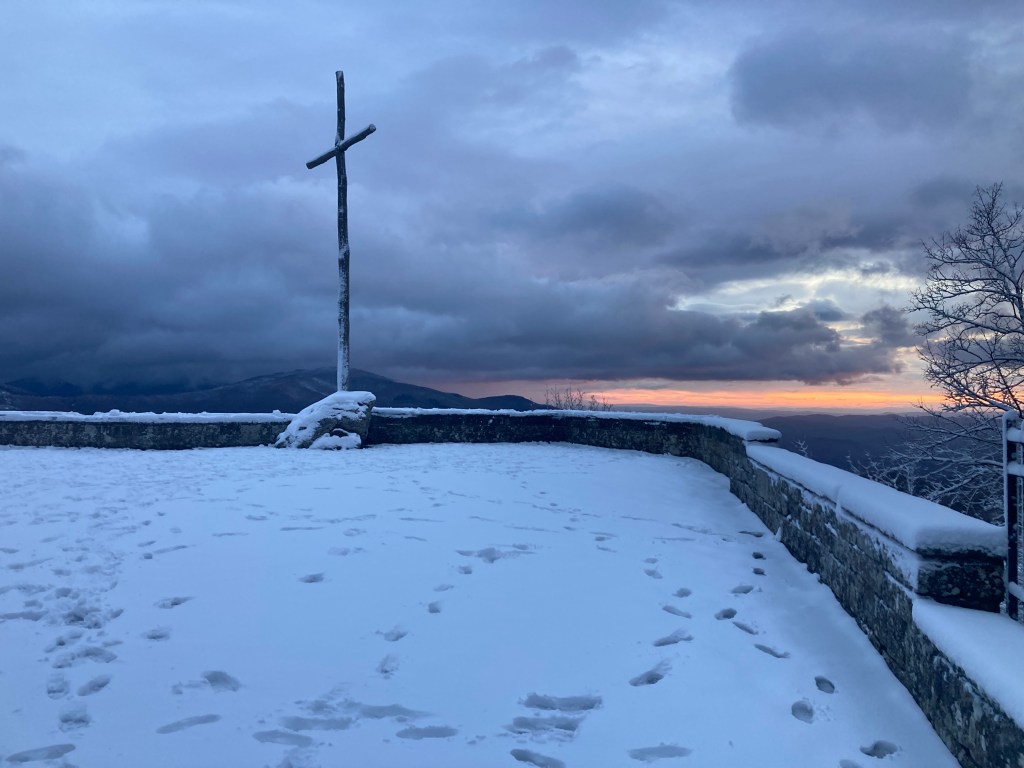
After lunch, we had one more stop, the Santuario della Verna, where Saint Francis de Assisi received the stigmata. Stefano and I were chatting, still buzzing from lunch, when we noticed snowflakes landing on the windshield. The flurries abated soon after we began our winding 1,000-meter climb toward the sanctuary, but evidence of a heavy snowfall surrounded us, softening the mood in the car to one of reverence and contemplation. We parked in the snow and with some haste attempted to follow in Stefano’s footsteps – his rugged leather boots were more suited for the weather than our respective footwear. He was smiling but also had the responsibility of safely returning us home before the weather deteriorated.
Stefano told us to wait in the lobby, which felt more like a museum than a residence. I had started to notice a pattern. We would arrive somewhere, Stefano would gesture to us and say a few quick words to the host (whom he ostensibly knew well, from having done these day trips many times), and we would easily gain entry. We followed Stefano.
After scurrying down various hallways and peeking into rooms as we rushed past trying to keep up with Stefano’s quick stride, we arrived at two closed windowless doors, the entrance to a place of worship. It was fitting that having spent our previous days visiting the grand architectural structures of Florence, this unassuming chapel would stop us in our tracks.
I could not tell if Stefano had been leading us here the entire time, or if he was just as curious as we were. He politely held the door open for us. As we entered, a nun sitting at the organ immediately began to play, as if she had been waiting for our arrival. We slowly walked forward, procession-like along the pews, taking care as our eyes adjusted to the soft lighting. The four of us stopped just behind where she was seated in front of the organ, studiously eyeing sheet music that was displayed on a laptop.
After a few verses she stopped playing and asked where we were from. Her smile held a kindness and gentleness I had not seen in a long time.
Her name was Sister Angela, and she was from Germany.
In Italy, I had been going by the name Clara. Just as when I travel in Spanish-speaking countries, the name proved easier when introducing myself to locals. But in this holy place, and put at ease by her welcome, I told her I was Conner.
We held each other’s gazes for more than a few moments.
She asked if she could play us a hymn.
Angela began playing and singing. She reached a point in the hymn where she realized that she would not reach the note. She calmly stopped, chuckling to herself at her mistake, and joyfully started again.
She sang. I made no move to wipe away a few quiet tears that had dislodged from somewhere deep within. She concluded and turned around on her stool, looking at me. “You’re perfect the way you are,” she said.
Back in the car, the echoes of the visit diminished along with our descent, finally dissolving completely as we returned to bustling traffic, the typical evening routines of locals, and functioning Internet. Stefano immediately put on Bill Evans, remembering my preference from earlier in the day.
He was once again planning a meal. Dinner with his girlfriend. I told my parents I would build a cozy fire once we got in.
Back at the sanctuary, snow would fall. Vespers would soon begin. Angela would return to her seat in front of the organ to practice.
I would be Conner.